


Kabale University Staff Urged to Uphold Governance Policies with Integrity and Compliance
 Kabale, Uganda | July 17, 2026
Kabale University has reinforced its commitment to good governance, accountability, and excellence in academic administration through a two-day Policy Dissemination and Legal Risk Mitigation Workshop aimed at strengthening compliance with institutional policies and reducing legal risks.
The workshop, organized by the Office of the University Secretary through the Legal Unit, brought together Assistant Academic Registrars, Heads of Department, and Administrative Staff in the Office of the Academic Registrar from 16th to 17th July 2026 at the University’s New Computer Laboratory. The engagement focused on the dissemination of the Kabale University Admissions and Registration Policy, 2026 and the Kabale University Examinations Policy, 2026, both approved by the University Council on 30th March 2026.
 Speaking during the workshop, the Deputy Vice Chancellor for Finance and Administration, Associate Professor Helen Musanabera Byamugisha, challenged participants to implement the newly approved policies with fairness, professionalism, and integrity.
She emphasized that all admissions to Kabale University must be conducted strictly on merit, noting that the policies were developed to minimize human error, promote transparency, and prevent malpractice.
“These policies are intended to guide us in delivering services fairly and consistently. Let us implement them without bias and always seek clarification whenever necessary. We must all become ambassadors of compliance within the University,” she said.
Associate Professor Helen further underscored the importance of policy adherence in safeguarding the University’s reputation and ensuring quality service delivery to students and stakeholders.
 The University Secretary, Mr. Baryantuma Johnson Munon, reminded participants that students today are increasingly aware of their rights and the legal framework governing higher education institutions.
He urged staff to carefully read and interpret admission letters and official documents before taking action, cautioning against making decisions based on emotions or assumptions.
“Let us strive to comply with the law. Reading and understanding the policies is critical because it helps us avoid mistakes. We should also view our students as clients deserving professional and responsive service,” he advised.
The workshop also featured expert presentations from legal practitioners and higher education governance specialists.
Counsel Agaba Saimon, Founding Partner and Advocate at Remedium Advocates, emphasized the importance of total compliance and defensible decision-making in institutional management.
He noted that organizations risk losing credibility when they fail to follow their own rules and procedures.
“Compliance is not optional. Every decision must be defensible. Errors can be corrected through the proper channels, but communication must always be clear, professional, and properly documented,” he said.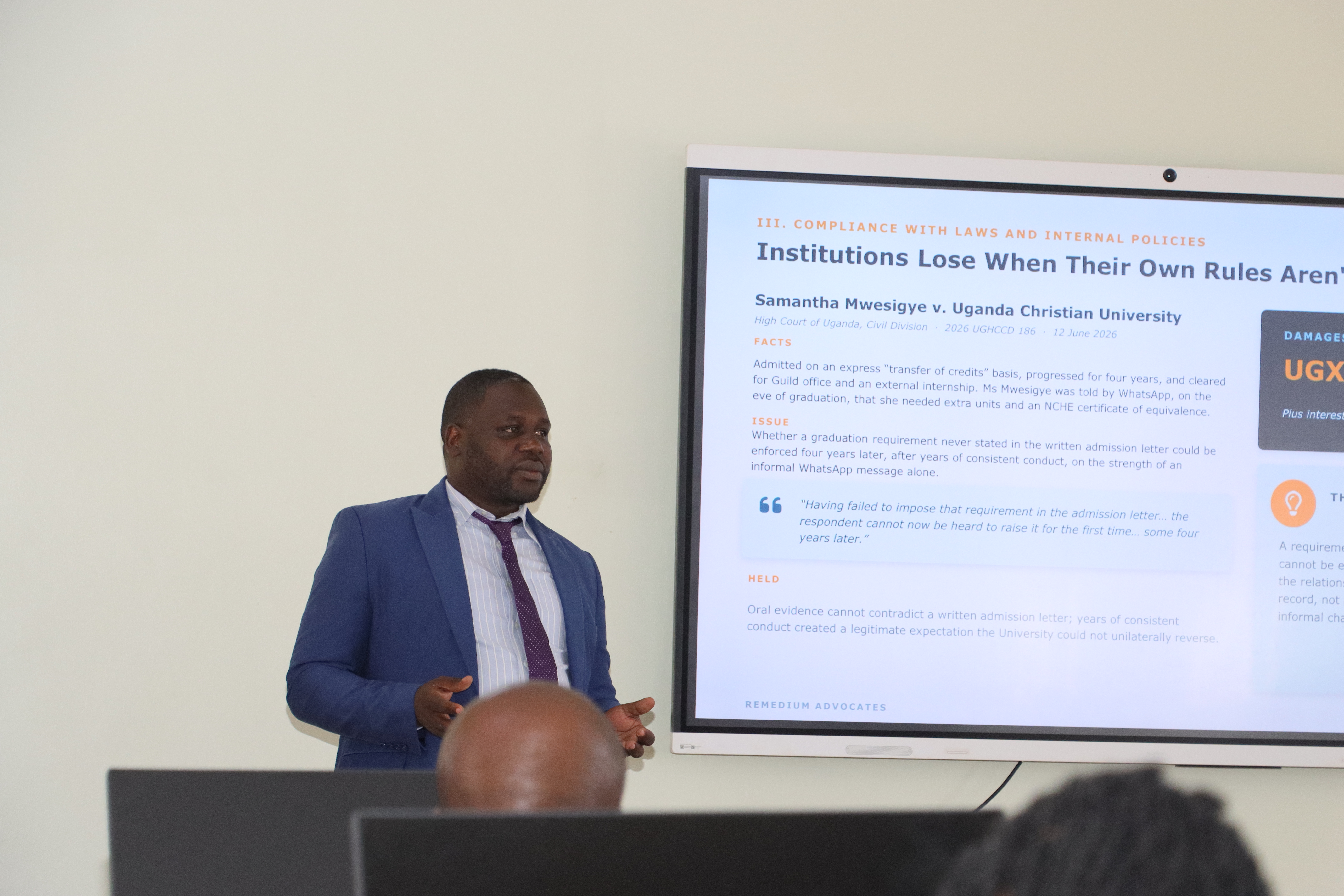
Counsel Agaba discouraged the use of informal communication platforms such as WhatsApp for official university matters, urging staff to utilize institutional email systems that provide verifiable records.
He further highlighted the link between compliance and quality service delivery, encouraging departments to establish and observe internal turnaround times for admissions, registration matters, and appeals.
“Silence often reads as unfairness. Every written complaint deserves a reasoned response. Institutions must communicate clearly and consistently to build trust and confidence,” he added.
In another session, Counsel Rajab Alinaitwe, Senior Lecturer at the Law Development Centre and Senior Partner at Interlink Associated Advocates, guided participants on translating policy into practice through procedural fairness and proper documentation.
He stressed that every administrative decision should be supported by evidence and made in accordance with established procedures to withstand legal scrutiny.
Counsel Alinaitwe also discussed the hierarchy of the courts, the doctrine of precedent, judicial review processes, and recent court decisions affecting public institutions. He explained that decisions may be challenged on grounds of illegality, irrationality, and procedural impropriety, making adherence to policy and due process essential.
Additional presentations were delivered by Judith Ahimbisibwe, Senior Legal Officer; Ms. Linda Wandira, Principal Assistant Registrar in the Office of the Academic Registrar; and Rebecca Nambafu, Legal Officer, who guided participants through the Universitys policy framework.



The facilitators noted that Kabale University currently operates under approximately 36 institutional policies derived from the Universities and Other Tertiary Institutions Act and the University’s governing legal framework.
The workshop forms part of the University’s broader efforts to strengthen institutional governance, enhance service delivery, and foster a culture of compliance across all administrative and academic units.
As Kabale University continues to grow as a leading public institution of higher learning, the emphasis on policy awareness and legal compliance remains central to achieving its mission of delivering quality education, research, innovation, and community service.
Discover more from Kabale University News
Subscribe to get the latest posts sent to your email.










Leave a Reply